Since my first week of lectures at The University of the West Indies, I have been eager to write about the extravagant professors at UWI. My view is geared towards the Faculty of Social Sciences, in which I was taking four psychology courses. Trinidad and Tobago (rather- the Caribbean as a whole) is known for running on an entirely different schedule of timings (or lack thereof). Knowing this, I channeled my inner zen in anticipation of long waits at the administration building and bus schedules which were very loosely followed. I did not expect it to apply to my classes, however!
Imagine my surprise when two of my classes consistently began 30-40 minutes after the actual start time. I was slower on the uptake than most, still showing up within 10 minutes of 5:00 PM and waiting around with the other earlybirds as the professor took his sweet time in arriving. He was a jolly man of Indian descent, with a thick graying moustache and a tendency to digress to talks of his family life.
In most classes at Towson, there is a clearly defined hierarchy in the room. Lecturers often close the door precisely the minute the class is due to begin, and any latecomers slink in ashamedly with their heads ducked, unacknowledged.
In my classes at UWI, the professor/student hierarchy is much more vague- if nonexistent- with a sassy, playful interaction. Students would arrive to class over 10 or 20 minutes after lecture began and pass by with a cheerful "good evening", to which the professor would interrupt his train of thought to respond with an equally kind "good evening". Several times during lectures, my professors would wander into the midst of the seating and settle themselves down on a bench beside the students, preferring a more balanced classroom than the teacher-at-the-podium setting. My Trinidadian professors made references to their participation in the drunken dancing festival of Carnival, a set of personal activities that would not be shared in the American classroom setting.
Comparably, I had a professor from England who had fairly recently begun to teach at UWI. Her style differed drastically from my Caribbean professors. She maintained the hierarchy of professor to students, standing in front of the classroom or atop the stage in the lecture hall, and using a microphone.
By the end of the semester, I was occasionally frustrated but overall appreciative of the quirky professor at UWI, each with their personality on full display.
Sunday, May 19, 2013

Sunday, May 5, 2013
Religious Representations
A few weeks ago, I was lucky enough to join a tour alongside
the western coast of Trinidad and Tobago. We climbed aboard a bus and
chugged into the heart of Chaguanas, stopping at two famous Hindu sites:
An ashram dedicated to Lord Hanuman and The Temple in the Sea. The
walls, floors, ceilings, and each doorway trailed colors, intricate
patterns rising into the sky. Hindu gods of every shape, size, and color
from the Ramayana sat peacefully in the center of the temple, greeting
visitors. Yet, even having been in Trinidad and Tobago for several
months, I feel I have not even begun to understand the depth of the
people here. Hinduism runs deeply within a large portion of Trinidad and
Tobago’s population, but it is a religion about which I know very
little.


I have also been exposed to the practices of the Spiritual Baptists. In particular, I watched a ritual of purification as a group of Spiritual Baptists bathed in milk and the waters of Maracas Waterfall. I have watched a group of men in traditional Rastafarian gear gather to enjoy each other’s thoughts on a sunny afternoon at the botanical gardens. I have seen trinkets celebrating the voodoo rituals (less common, but certainly established) in Tobago.
Despite my fascination will all these practices, I have not had enough time to fully learn about each of the groups that bring their own flavor to Trinidad and Tobago’s rich cultural stew. Still, I know that seeing these new rituals has opened my eyes to the fact that the world holds so much that I do not yet know. Knowledge is my greatest academic, professional, and personal goal now. I have a passion to learn about all these practices, and perhaps be able to value and utilize them in better understanding the patients with whom I will work in the field of medicine.


I feel that I will not grasp the full impact of my study abroad experience on my understanding of the world until I return to the United States and absorb the changes. Embracing the different cognitions and practices around the world is undoubtedly a great help in any career, and will help to build stronger relations between myself and others I meet. I am now, more than ever, eager to learn!
Tuesday, March 19, 2013
Tranquility in Trinidad and Tobago

Shalimar house
There are few things in the world better than sinking into pastel cushions on a breezy patio with the sun streaming over you and the wind chimes swinging a sweet melody from the palm tree over your head. Alongside all these sounds is the softest fluttering of pages, a good book in the mix. 
Chaguaramas, post-kayaking river scenery


Las Cuevas beach in Trinidad
It is moments like these that help me feel the Caribbean vibes, really and truly. There is a feeling of totally relinquishing duties and stress to become one with the present, absorbed into the beauty of the moment. Here, you can forget the bustle of life and breathe for hours in the tranquility, feel the sweet serenity.

Brasso Seco and Double River Waterfall
The beauty of Trinidad and Tobago is that it has some marvelous architectural pieces, but its main draw is the nature. The natural, untouched environment welcomes people to come explore and gaze in wonder at the miracles of the world. On an early Sunday morning, I joined the University Health and Fitness club for a hike to Brasso Seco.


Brasso Seco is an agricultural community, originally focused on cocoa and coffee, located in the northern range of Trinidad. Now, it is full of a rich local culture with a love of food and music. After the longest hike of my life, to a flourishing forest completely adorned with a rush of water arcing over the cliffs, we had the chance to try the indigenous foods.
Brasso Seco village is particularly well known for their smoked meats, cooked outside over a low fire throughout the day. Banana leaves cover the cooking meat to capture the smokey flavor. As our bus weaved through the streets, the smokey aromas of cooking meats twisted in through the windows and rode home with our group of hungry hikers!
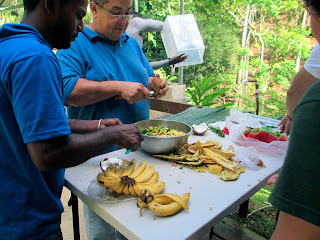
It is traditional for the group to make chow after the hike. The maxi driver began by slicing a pineapple and slapping away our hands as we tried to snatch pieces from the bowl. He mixed the pineapple with coconut jelly, bananas, parsley, black pepper, salt, and some of the spiciest peppers you can find. What resulted was a delicious, savory, and highly painful experience for the tongue. The peppers were unbearably hot, but a side of sliced watermelon eased the burning tongue!

Roads carved in mountains/ precarious twists and turns/ shake hands with nature.
Swimming in the forest/ canopy of virescence/ All the world below.


Brasso Seco is an agricultural community, originally focused on cocoa and coffee, located in the northern range of Trinidad. Now, it is full of a rich local culture with a love of food and music. After the longest hike of my life, to a flourishing forest completely adorned with a rush of water arcing over the cliffs, we had the chance to try the indigenous foods.
Brasso Seco village is particularly well known for their smoked meats, cooked outside over a low fire throughout the day. Banana leaves cover the cooking meat to capture the smokey flavor. As our bus weaved through the streets, the smokey aromas of cooking meats twisted in through the windows and rode home with our group of hungry hikers!
It is traditional for the group to make chow after the hike. The maxi driver began by slicing a pineapple and slapping away our hands as we tried to snatch pieces from the bowl. He mixed the pineapple with coconut jelly, bananas, parsley, black pepper, salt, and some of the spiciest peppers you can find. What resulted was a delicious, savory, and highly painful experience for the tongue. The peppers were unbearably hot, but a side of sliced watermelon eased the burning tongue!


Roads carved in mountains/ precarious twists and turns/ shake hands with nature.
Swimming in the forest/ canopy of virescence/ All the world below.
The Mystical Workings of Maracas Waterfalls
 On a lovely weekend morning, I ventured to Maracas Waterfalls with a group of fellow students. After a short hike in the lush, green forest surrounding, we found ourselves climbing into a grand opening to take in the largest waterfall in Trinidad. In the midst of the foliage was pathway of large rocks and boulders leading to the area under the falls. Beneath the curtain of falling water, there stood cluster of people dressed in various degrees of classiness.
One older woman perched on a boulder beside the falling water, mist billowing over her thick, dark robes. I saw her lips moving in endless speech as she tilted her head back and poured a white liquid over her face and down her jacket. Several other people stood beneath the falls (which we realized later was a very strong current of water) and chanted loudly in prayer while washing themselves in a combination of milk and water. These substances represent purification of the body and soul.
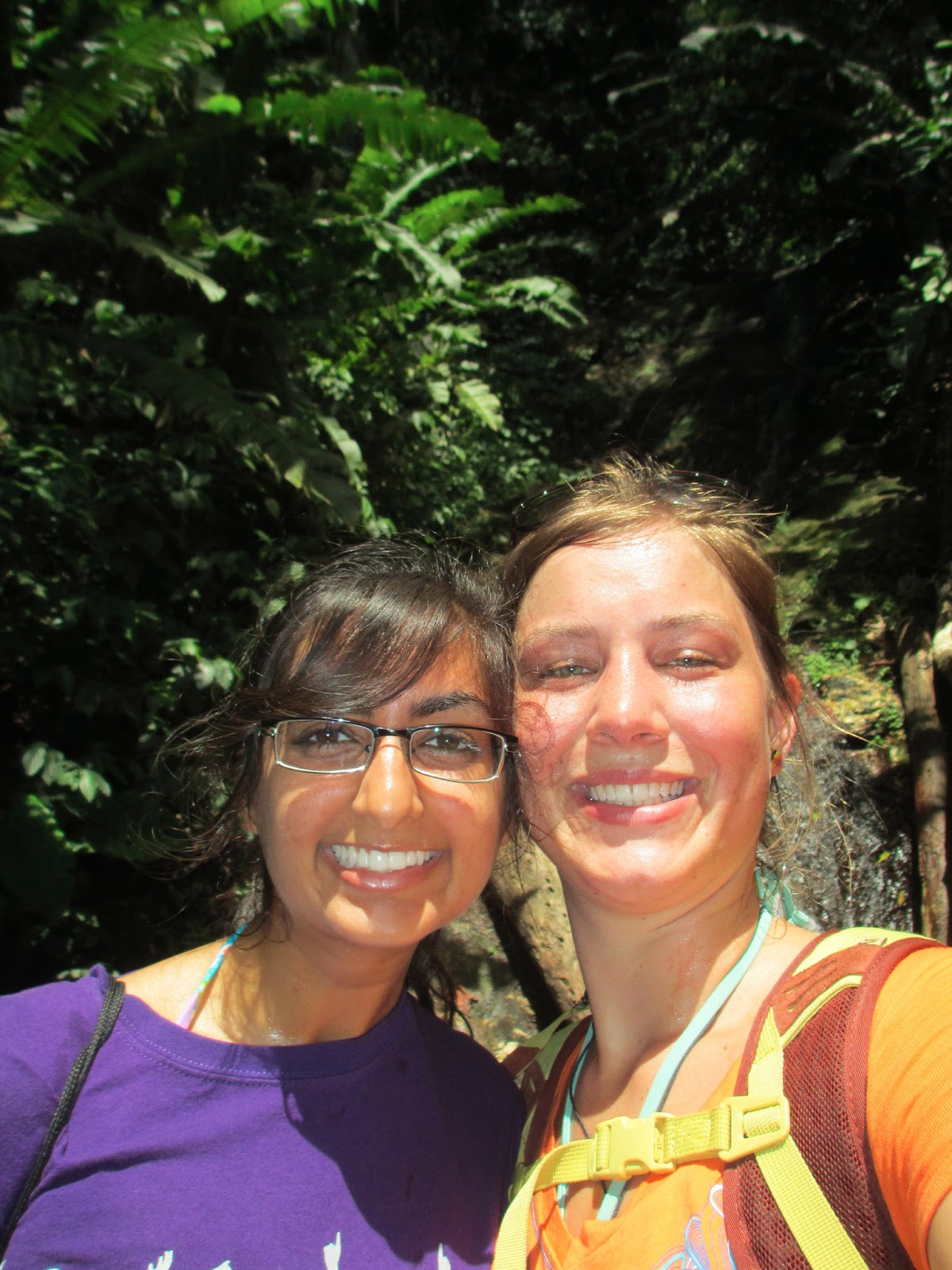


After asking a few locals, we realized these were the Spiritual Shouter Baptists, known particularly in Trinidad and Tobago (a country which banned the practice in 1917 and later repealed the ban, giving the Spiritual Baptists their own national holiday on March 30th)! Spiritual Baptists consider themselves to be Christians with elements of traditional African religion. It was brought to Trinidad by the "Merikens", former American slaves.
The woman in the long gown was a regal sight to behold. She walked with a large stick, its wood rough and oddly shaped. Despite her tiring limbs, her movements had great purpose and strength. She kindly explained to us curious travelers what her practices meant, describing the water and milk as purifying sources to the body and the Baptist hymns, the "moaning", as a way of fasting… feeling the power of the Holy Spirit.


Wednesday, February 13, 2013
Soca Soiree and Carnival Craziness
Soca music, as indicated by one of my current favorite songs above, has been the theme for this past week. The Carnival festivities began bright and early on Friday, with the Dragon Festival and steel pan drums dominating town all day [see last post]! As the sun dipped below the horizon, the preparations began for International Soca Monarch, an annual competition held on Carnival Friday (it's Fantastic Friday!). This soca frenzy began around 9PM and lasted until 4AM. I have yet to develop the party stamina here!


Carnival has been a period of amazement and the removal of some misconceptions. I lost track of time in the pursuit of enjoyment. I truly began to understand some of the beautiful traditions in Trinidad and Tobago! I would return to celebrate these days in a heartbeat.
Sunday, February 10, 2013
Pre-Carnival Pleasures
Good Afternoon!
This week, I experienced my first taste of Carnival traditions, as tourists flock to Trinidad and Tobago, and the celebrations begin to climb toward the Mas frenzy on Monday and Tuesday!

On Friday, we ventured into Port of Spain for the Dragon Festival and a small traditional Carnival performance. The whole concept of Carnival and "playing mas" or masquerade is about an elaborate performance of mimicry and masks. Some say Carnival takes "time out of time" by emphasizing fluidity in the passage of time and releasing revelers and all participants from the pressing matters of real life. The characters seen in parades throughout the week are symbolic of the history of Trinidadian culture.

The Bookman (also, Gownman or Ruler) is a devil mas portrayal, surrounded by imps and beasts. He carries a pen and a book in which he writes the names of prospective souls for the devil. While I watched the Bookman do his waltz through the streets, I caught a glimpse of names in his book. Some I did not recognize, but the name "Christopher Columbus" was immediately recognizable!


Jab "devil" Molassie "molasses" is one type of devil in devil mas. He carries a pitch fork and his body is smeared in grease, mud, or coloured dyes (in this case- blue all over)! His imps play rhythms on pan drums, while he wines and gyrates wildly, held back only by a chain.


The Dragon is the fire-beast from hell, bringing destruction to the streets. If the dragon comes across a pool of water in the road, the "holy water" being of Heaven leaves the Dragon frustrated. The imps taunt him and he must finally dance in submission and try with great effort to leap over the water.


I was quite amused to find that one of the Dragon characters in the parade was incredibly intoxicated. His Dragon would have quite a struggle had he encountered any holy water in his path. He stumbled, dancing on his knees and appearing to fall headfirst into the ground several times. He also convinced someone to light his cigarette, which he smoked inside the costumed dragon head. All in all, his performance was perhaps the most amusing, feeling effortless, fun, and a little dangerous!
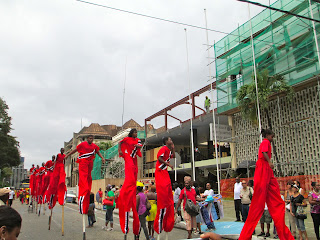

I encountered a few more characters, but I will see the full lot at the big Carnival parades on Tuesday! Look for another more detailed post, including J'Ouvert and Mas.

This week, I experienced my first taste of Carnival traditions, as tourists flock to Trinidad and Tobago, and the celebrations begin to climb toward the Mas frenzy on Monday and Tuesday!

On Friday, we ventured into Port of Spain for the Dragon Festival and a small traditional Carnival performance. The whole concept of Carnival and "playing mas" or masquerade is about an elaborate performance of mimicry and masks. Some say Carnival takes "time out of time" by emphasizing fluidity in the passage of time and releasing revelers and all participants from the pressing matters of real life. The characters seen in parades throughout the week are symbolic of the history of Trinidadian culture.

The Bookman (also, Gownman or Ruler) is a devil mas portrayal, surrounded by imps and beasts. He carries a pen and a book in which he writes the names of prospective souls for the devil. While I watched the Bookman do his waltz through the streets, I caught a glimpse of names in his book. Some I did not recognize, but the name "Christopher Columbus" was immediately recognizable!


Jab "devil" Molassie "molasses" is one type of devil in devil mas. He carries a pitch fork and his body is smeared in grease, mud, or coloured dyes (in this case- blue all over)! His imps play rhythms on pan drums, while he wines and gyrates wildly, held back only by a chain.


The Dragon is the fire-beast from hell, bringing destruction to the streets. If the dragon comes across a pool of water in the road, the "holy water" being of Heaven leaves the Dragon frustrated. The imps taunt him and he must finally dance in submission and try with great effort to leap over the water.


I was quite amused to find that one of the Dragon characters in the parade was incredibly intoxicated. His Dragon would have quite a struggle had he encountered any holy water in his path. He stumbled, dancing on his knees and appearing to fall headfirst into the ground several times. He also convinced someone to light his cigarette, which he smoked inside the costumed dragon head. All in all, his performance was perhaps the most amusing, feeling effortless, fun, and a little dangerous!
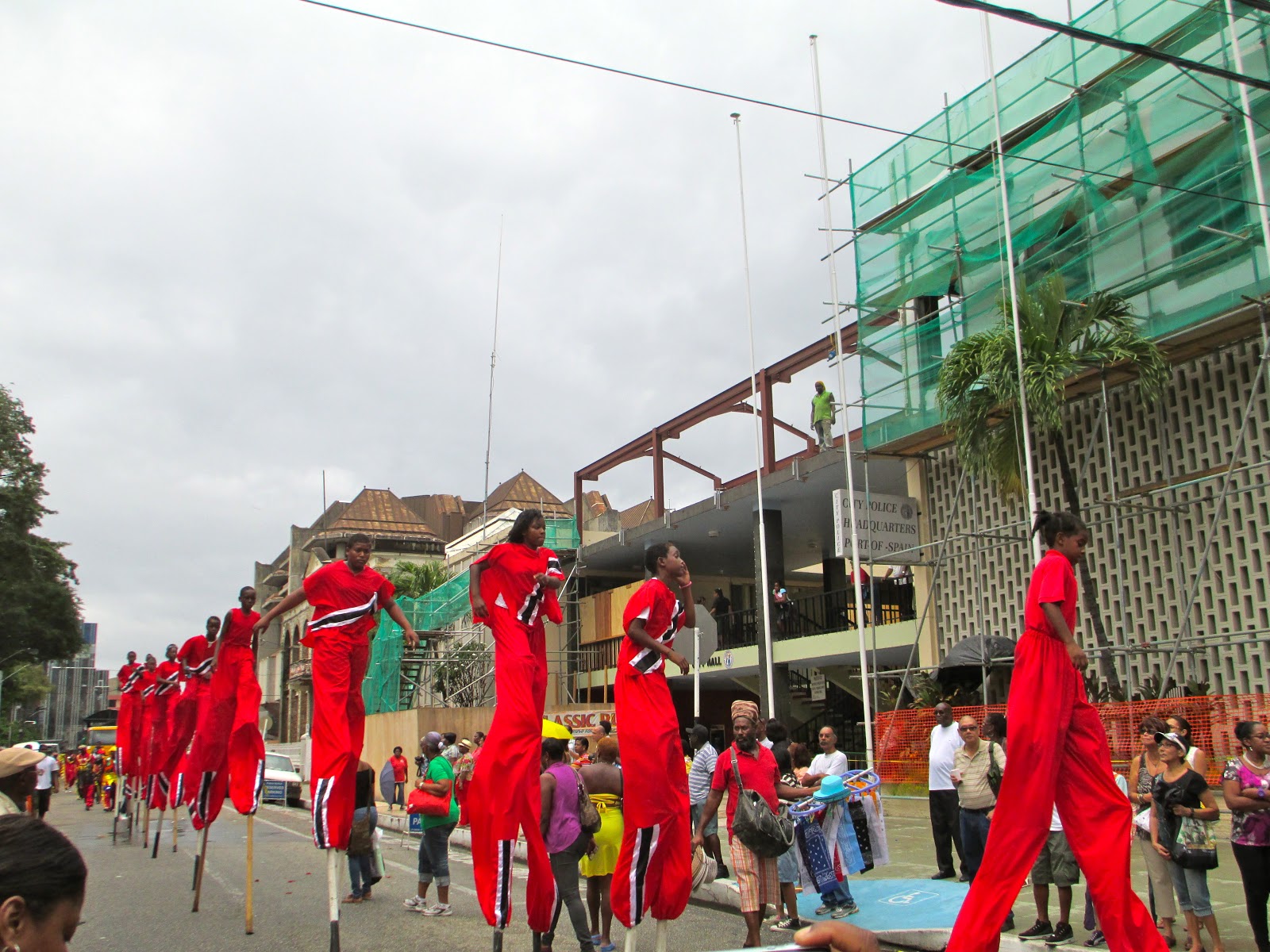

I encountered a few more characters, but I will see the full lot at the big Carnival parades on Tuesday! Look for another more detailed post, including J'Ouvert and Mas.

Subscribe to:
Posts (Atom)